
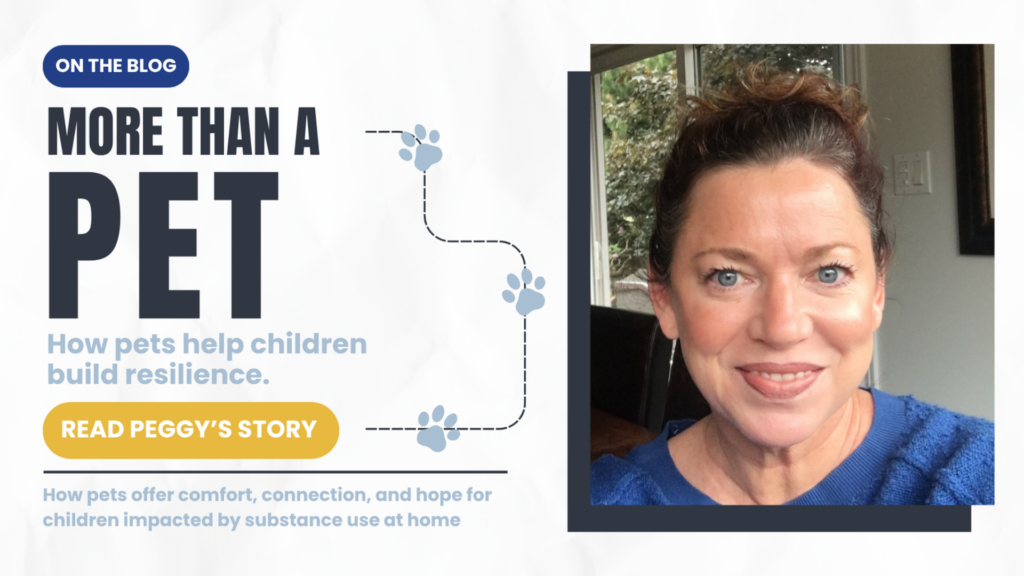
More Than a Pet: Building Resilience in Children Living with Family Addiction
I work with children—young children who are growing up in families impacted by a parent’s substance use disorder. One of the first lessons I learned from a cherished mentor was that if you want to truly connect with children, you have to step into their world. Be curious. Ask questions. Listen to what matters to them.
More often than not, those conversations lead to their pets.
I’ve heard countless stories about beloved dogs, mischievous cats, sneaky lizards, rabbits, guinea pigs, and even chickens. When children talk about their pets, something changes. Their faces brighten. They smile. They laugh. For a moment, the worry and uncertainty they often carry seems just a little lighter.
At the National Association for Children of Addiction (NACoA), we often talk about building protective factors and recovery capital—the relationships, strengths, skills, and resources that help children not only survive adversity but thrive despite it. While we often think about caring adults, teachers, coaches, or mentors as sources of resilience, we sometimes overlook another important relationship in a child’s life: the bond they have with a beloved pet.
Animals have an incredible ability to help children feel safe, connected, and accepted. They don’t judge. They don’t ask difficult questions. They simply show up with unconditional love and consistency—two things that can be life-changing for children living in unpredictable environments.
Research suggests that companion animals are associated with many of the protective factors that support resilience. While a pet cannot eliminate the challenges of growing up in a family affected by addiction, that relationship can become an important source of comfort, stability, and hope.
Some of the ways pets can help children build resilience include:
- Providing unconditional love and acceptance, helping children feel valued simply for who they are.
- Reducing feelings of loneliness and isolation, particularly for children who feel they have no one to talk to.
- Offering emotional comfort during stressful moments, helping children regulate difficult emotions.
- Creating predictable routines and structure through daily feeding, walking, grooming, and play.
- Teaching responsibility and empathy by caring for another living being.
- Building confidence and self-esteem as children experience success in nurturing and protecting a pet.
- Encouraging physical activity and play, both of which support emotional and mental well-being.
- Helping children practice healthy attachment and trust, particularly when relationships with adults have been inconsistent.
- Creating opportunities for social connection, as pets often become conversation starters and shared interests with others.
- Providing a sense of purpose and hope, reminding children that they matter and that someone depends on them.
I’ll admit, I understood all of this professionally long before I understood it personally.
Then Fred came into my life.
Fred was just eight weeks old when I brought him home. Like most puppies, he was equal parts adorable and exhausting. There were sleepless nights, chewed shoes, endless training, and plenty of moments when I wondered what I had gotten myself into.
But somewhere along the way, Fred stopped being “my dog” and simply became family.
The joy he brings me is difficult to put into words. He makes me laugh every single day. He gets me outside when I need fresh air. Somehow, he always seems to know when I’ve had a hard day, quietly resting his head on my lap without asking for anything in return.
Working with children has taught me that resilience doesn’t grow from one big moment. It grows through thousands of small, consistent experiences of feeling safe, seen, loved, and connected.
That’s exactly what NACoA strives to create for children through our programs. Every caring adult, every trusted mentor, every positive peer relationship, every safe place to belong adds to a child’s recovery capital. Each relationship becomes another thread in the safety net that helps children navigate adversity and believe in a future filled with possibility.
Working with children has taught me that resilience doesn’t grow from one big moment. It grows through thousands of small, consistent experiences of feeling safe, seen, loved, and connected.
Sometimes those life-changing relationships come from parents in recovery, grandparents, teachers, counselors, or coaches.
And sometimes they come with four paws, a wet nose, and a wagging tail.
When we invest in relationships—whether they’re with caring adults, supportive peers, or beloved animals—we’re doing more than helping children cope with today’s challenges. We’re helping them build the resilience, confidence, and hope they need to change the trajectory of their lives.
Because every child deserves someone who helps them feel safe, valued, and never alone.
Peggy McGillicuddy, Director of Children’s Programs, NACoA