The Funeral Ends. Their Story Doesn’t.
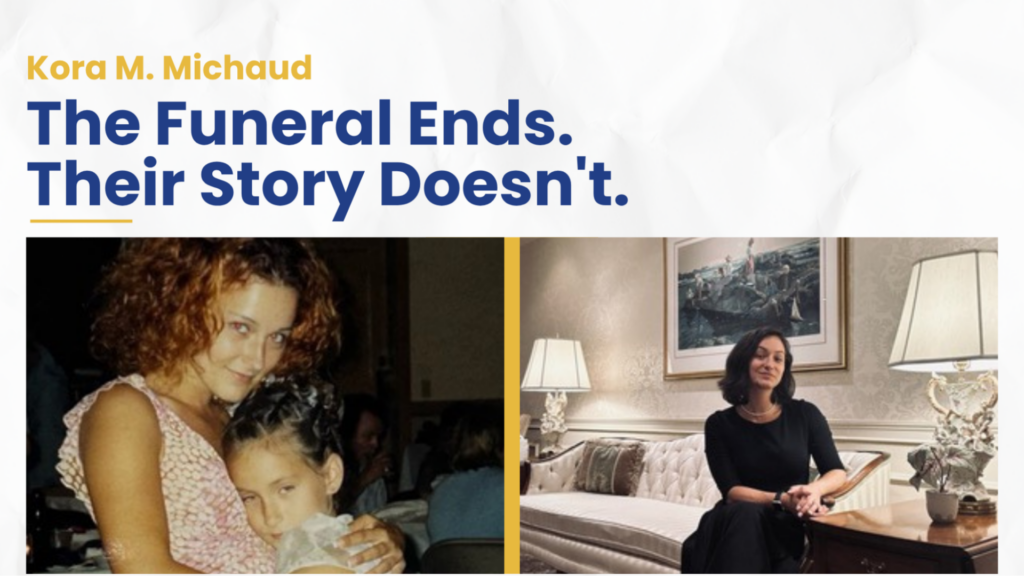
Author: Kora M. Michaud Funeral Director & Embalmer MA & NH
They probably think I forgot them. I didn’t. People assume funeral directors move on because we have to. The service ends. The flowers are gone. The next call comes in. Life keeps moving.
People have a way of staying with you. Not because you decide to remember them. Because one ordinary moment brings them back. A song. A road. A restaurant. A motorcycle. A baseball field. A nursing home.
All of a sudden, you’re not thinking about what you’re doing anymore. You’re thinking about a family you met years ago. The husband who wanted no services after years in and out of treatment centers. The grandmother who spent years trying to keep her grandson alive. The mother who apologized for crying because she thought she’d already cried enough. The little girl who never let go of her grandfather’s hand. The teenager who barely spoke through the arrangement conference, and I still wonder how he’s doing.
Those moments don’t leave. Neither do those families.
That’s what finally made something click for me. We meet families after years of addiction. After the ambulance rides. After treatment. After relapse. After hope. After heartbreak. After every promise that this time would be different.
By the time they sit across from us, they’re not just planning a funeral. They’re carrying years of surviving someone they love.
Sometimes the person making the arrangements has been sober for ten years. Sometimes they’re actively using themselves. Sometimes it’s the grandparent who’s been raising children all over again. Sometimes it’s the spouse who’s spent years waiting for the phone to ring. Sometimes it’s the child who’s never known life without addiction somewhere in the house.
For a couple of hours, they’re all sitting around the same table. We call it an arrangement conference.
I’ve started wondering if it’s also one of the few places where every person whose life has been shaped by one addiction is gathered together at the same time.
The longer I’ve been in funeral service, the less I remember the flowers, the caskets, or what tie I wore that day.
I remember people. I remember one grandmother who buried her son after addiction took his life. A few years later, she was sitting across from me again. This time she was planning her grandson’s service.
I remember another grandmother who finally believed her family had made it. Years earlier, addiction had taken her husband while her children were still young. She had already spent a lifetime watching addiction reshape her family.
Her son had fought hard for his recovery after years of battling through it. He had regained custody of his three children after their mother relapsed. She talked about him with a kind of relief I hadn’t heard before. Those kids were finally home. They were finally safe.
She went to work believing the hardest years were finally behind them. She came home to find her son dead in one of the children’s bedrooms.
The funeral wasn’t what stayed with me. It was everything waiting for her after it. Three children trying to understand what happened. Another custody fight. Another generation growing up in addiction’s shadow.
I still wonder how they’re doing.
I think about the nineteen-year-old who buried her husband before either of them had really started their lives. I wonder who called her six months later. Who helped her understand that grief after addiction doesn’t fit neatly into a pamphlet. Who helped her build a life after everyone else had gone back to theirs.
I don’t have to wonder what came after the funeral. I’ve lived it.
When my mom died, I was an apprenticing funeral director. I knew exactly what to do for her funeral. I had no idea what to do for myself.
I got the call while I was driving my boss to pick up a rental car. My mom’s boyfriend told me she was at the Medical Examiner’s Office. She had overdosed.
The first thought that crossed my mind wasn’t the funeral. It was, “How am I supposed to tell everyone at work?”
Not because I was ashamed of my mom. Because I was terrified of what people would think.
So I did what I knew how to do. I became the funeral director. I organized. I talked with the landlord. I sorted unpaid bills. I packed up a life addiction had left behind.
My children and I had driven out of state to spend my week off cleaning out their grandmother’s apartment after the Medical Examiner released the scene and the biohazard cleanup was finished.
That wasn’t the week we had.
Before we carried out the first box, I found my mom’s boyfriend dead in the apartment after he overdosed on the same drug that had taken my mom three days earlier.
My children waited while I dealt with another overdose. Then we went back to what we’d come there to do. We packed up their grandmother’s life into boxes and loaded them into a storage unit.
None of that happened inside a funeral home. Every bit of it was part of addiction.
That shoebox changed more than the way I remembered my mom. It changed the way I looked at every family sitting across from me. I realized funeral directors have been caring for families living with addiction all along. We just haven’t always realized the funeral doesn’t have to be the first time we help them.
Ever since then, I’ve found myself asking a different question.
Not what families need for the service.
What they’ll need after it.
Maybe the answer is a recovery meeting. Maybe it’s an overdose grief group. Maybe it’s a peer recovery coach. Maybe it’s resources for grandparents raising grandchildren. Maybe it’s support for children trying to understand addiction.
Sometimes it isn’t about having the answers. It’s about knowing who does.
I don’t think funeral directors are supposed to become addiction counselors. I don’t think funeral homes can solve addiction.
But I do think we’re in a position few other professions ever experience.
The flowers eventually come down. The cars leave. The thank-you cards get written. The casseroles stop coming. The funeral ends. The belongings get stored away.
For the family… That’s often when the hardest part begins.
I’d like to think that before they walk back out our doors, we can make sure they don’t have to begin that part alone.
To say, “You don’t have to figure this out alone.” To hand a family more than a death certificate. Maybe it’s a list of local recovery meetings. A grief group specifically for overdose loss. A support organization for grandparents raising grandchildren. Resources for children. Information about treatment. Crisis numbers. Peer recovery coaches.
Maybe every family who walks through our doors after an overdose leaves with the same folder. Quietly. Every time. No one singled out. No one having to ask. Recovery resources. Grief support. Al-Anon. Nar-Anon. Peer recovery coaches. Resources for children. Support for grandparents raising grandchildren. Not because everyone will use every resource—but because addiction has never been good at announcing who it’s hurting. The person who needs it most shouldn’t have to be the one brave enough to ask for it.
I just know that after spending years remembering these families… I don’t think our responsibility ends when the service does.
Not assumptions. Not judgment.
The person quietly wondering if they’re ready for treatment doesn’t have to identify themselves. The spouse doesn’t have to admit they’re exhausted. The grandparent doesn’t have to ask where to turn. The teenager doesn’t have to wonder if they’re the only one living this life.
I’ve also started wondering if this is where our professions finally meet. Not after another overdose.
Before one.
That’s why I think we need each other.
To the addiction and recovery community, our profession needs your help.
Come into our funeral homes.
Teach us what families need after they leave us.
Help us understand the questions people don’t know how to ask.
Help us build resource guides every family can quietly take home, whether they’re in recovery, actively struggling, grieving someone they’ve lost, or loving someone who’s still here.
Help us create something no family has to search for while they’re drowning.
To my fellow funeral directors… Invite them in. Build those relationships before the next family needs them. Know where help exists in your community. Know your recovery organizations. Know your peer recovery coaches. Know your overdose grief groups. Know your Al-Anon and Nar-Anon meetings. Know where to send the grandmother raising children. Know where to send the nineteen-year-old widow. Know where to send the son who quietly says, “I think I need help.”
If families trust us with one of the hardest days of their lives, we should know where to point them when tomorrow comes.
We also need to be willing to have harder conversations.
Not to tell families what they should write in an obituary, that decision will always belong to them, but to understand why honest, compassionate conversations about overdose matter.
Stigma thrives in silence. Recovery doesn’t.
Funeral service has an opportunity to help change that conversation. Not by leading it alone. By joining the people who’ve been leading it all along. Because addiction doesn’t care how much money you make. It doesn’t care what your last name is. It doesn’t care what you do for a living. It can walk into any home. It walked into mine.
For years, I worried what people would think if they knew my mother died from an overdose. Not because I was ashamed of her. Because I was afraid of the assumptions that would follow.
I don’t want another daughter, or another funeral director, to carry that kind of silence.
I don’t believe funeral service has all the answers. I believe we’re standing in a room full of people who need them.
If we’re trusted to care for families after a death, I think we can also help them find hope for the life that’s still in front of them. Because I’ve buried enough families to know the next one is already out there.
I’d rather meet them before the obituary. I’d hate for us to waste that opportunity.