Growing Up with Addiction

Our guest blogger is Tian Dayton MA PhD TEP, a clinical psychologist, certified trainer in psychodrama, sociometry, and group psychotherapy, and Senior Fellow at The Meadows. She is the creator of Relational Trauma Repair (RTR) and author of fifteen books, including “Growing Up with Addiction” and “Treating Adult Children of Relational Trauma,” and a former professor of psychodrama at NYU. A recipient of multiple national awards, she has appeared as a guest expert on major media outlets. Dr. Dayton has been a longtime partner of NACoA and sits on NACoA’s Advisory Board.
When we talk about Alcohol Awareness Month, it can feel like we’re talking about someone else. A person with a drinking problem. A cautionary AUD (alcohol use disorder) statistic. Something clinical and distant. But here is what I know professionally, as a psychologist, and personally, as an Adult Child of an Alcoholic (ACoA): there is nothing distant about it. The disease of addiction in a family couldn’t be more up close and personal.
When We Talk About Addiction, We're Talking About a Family
For a long time I have felt that the words alcoholic/addict have felt desensitized or distant, buried under images of celebrities in sunglasses entering treatment, or words like stigma and shame. And it is also sad to me that the focus remains on the the afflicted person themselves. We are preoccupied with their dilemmas, will they get sober, will they stay sober?
But what about the family? What about those of us who suffered mightily growing up with addiction and all of the mind, heart and soul bending relational dynamics that surround it; who grew up in a sea of other people’s denial and shame. What about us?
Because addiction doesn’t live only in the person who drinks. It lives in the whole family. It lived in my family and maybe yours, too.
It lives in the child who learns to read the facial expressions, tone of voice, gestures, posture and moods of everyone at the breakfast table, before they settle into their chair. In the teenager who perfects the art of anything from invisibility to acting out, who finds other houses to spend the bulk of their time in, who finds warmth, love and reliability (or escape) outside of their home. In the adult who, decades later, cannot explain why they can manage crisis smoothly, but predictable calm makes them want to scream; why intimacy feels risky, and relationships are intense.
Why do these effects last so long in so many?
Because one parent’s addiction doesn’t stay inside them. The pain and chaos radiate outward. The behaviors that surround a drunk or high state — the moods, the unpredictability, the silences and the explosions — seep into everyone until they become the very atmosphere of the family. They get absorbed into the walls, into the nervous systems of children, into the unspoken rules about what is safe to feel and say and need.
What passes from generation to generation is not the alcohol itself. It is everything that surrounds the alcohol — the behaviors, the emotional states, the distorted ways of relating that form when a family organizes itself around a substance rather than around each other.
We can treat the substance use. We can count the days of sobriety. But what we cannot so easily treat — what too often slips beneath the radar — are the long-term traumatizing effects that addiction leaves in the people who loved the person drinking or using. Those effects don’t disappear when the bottle is put down. They stay inside each person who has absorbed them, and they keep generating dysfunction long after the substance is gone.
Throughout childhood, these hidden wounds throb silently beneath the surface — inside each person, each relationship, the family as a whole — ever threatening to break through at the slightest provocation. And because naming things gets you into trouble in a home impacted by the substance use and trauma, most of us never had words for what we were carrying. We didn’t even know it was there.
So everything that addiction left in its wake — the distorted thinking, the hypervigilance, the mistrust, the depression and anxiety — followed us through childhood and into adulthood without ever being called by its name.
And here is the critical point: these wounds surface most intensely in the two places we are most exposed, most needed, most unable to keep our guard up.
In the way we love a partner. And in the way we raise our children.
This article is about this invisible inheritance. About the wounds that travel, not in the blood, but in the behavior, the nervous system, the unconscious twisted logic we hand to our children even when we are trying our hardest not to.
The Nature of Trauma: Why We Don't Know We Have It
The very nature of trauma is that we cannot fully feel it. Consequently, we don’t know we have it, nor do we understand how we pass it along.
The first thing we have to understand is that the parent-child relationship means survival for the child. The parent holds the keys to the house, the car, the food supply, and the love supply. So rupture with the parent means rupture with the self for the small child. The next thing to understand is that when children are hurt in these very primary attachment relationships, and the parent isn’t cuddling or talking them back into a state of calm and co-regulation, they lose their path to self-regulation — because children learn to self-regulate through successful co-regulation. So the child has no choice but to bury that hurt, to minimize, deny, and pretend it isn’t there… so they can keep going, so they can stay connected to the parent who is so primary to their survival, and the family who is their home. When children have to hide this pain from their parents, they also have to hide it from themselves. They grow up unconscious and unaware of the pain they carry.
And that is one of the reasons it has such a lasting hold on us.
We can’t get better from something we don’t think we have.
When a child grows up in a home organized around addiction — around a mix of love and care interwoven with unpredictability, fear and emotional unavailability — their developing nervous system does what any nervous system would do: it adapts. It learns what it must do to stay connected.
Children in these homes do not go numb or dissociate or bury their true emotions because it’s their preference. They do it because they figure out that it’s their way to stay connected in a family that constantly feels like it might fall apart.
But when the parent you love is the one hurting you, it becomes a double whammy for any child. Because not only are they being hurt, but the person nature meant for them to turn to for love, support and to understand what just happened is the one hurting them. And probably even blaming them.
Children cannot afford to see this clearly. So they do what children do. They go along with their parent’s denial and pretend everything is fine. Or they internalize the problem and make it somehow about themselves. They reason that they are somehow too much. Too needy. Too sensitive. That love is supposed to feel like this.
Kids in these families become remarkably, heartbreakingly adaptable. They learn to perform competently, to manage the moods of others, to disappear, to over-function, to become the family hero or the family clown or the family scapegoat. Sometimes they develop what clinicians call a false self, a version of themselves that works better in their family than being who they truly are and feeling what they truly feel. They invent strategies that allow them to remain connected to the family system, even when that system is killing them inside.
And part of this adaptation, well most of it really, is unconscious, they don’t know that they are doing it and they don’t know why they are doing it, they’re kids just getting by. Trying to make sense of addictive behavior that makes no sense. Trying to create a patch of safe ground to stand on when the rug is regularly being pulled out from under them.
This lack of solid ground, this distortion and denial of what’s happening, and sense of emptiness where a predictable home structure should be, is traumatizing for a developing child who is trying to build a self, to understand their own feelings and piece together a working model of the world and their place in it.
Adult Children of Alcoholics don't know what normal is.
-Janet Woititz, Author of Adult Children of Alcoholics-
Sarah, 38, came to therapy presenting with what she described as “anger management problems.” She was a devoted mother, a high-functioning professional, and by all outward measures, nothing like her alcoholic father. She had left that house at 18 and never looked back. It took fourteen months of therapy before Sarah could say, quietly, “I think I’ve been bracing for something my whole life. I just never knew what. It’s like I feel haunted inside but I can’t see what’s haunting me.” She had cPTSD (Complex Post-Traumatic Stress Disorder), a mental health condition resulting from chronic, long-term trauma – often in childhood – where escape is difficult. It includes typical PTSD symptoms plus severe emotional regulation issues, feelings of worthlessness, and strained relationships and is treated through psychotherapy and medication. Yet she had never once thought of herself as having experienced relational trauma in her childhood. She thought she was just “a little touchy, difficult, or had exceptionally high standards.”
How Trauma Travels: Unconscious Attachment Wounds and Cognitive Distortions
What I have observed over the years is that two of the main vehicles through which pain gets passed down are unconscious, frozen, and unresolved attachment wounds and cognitive distortions, through the way we learned to love, and learned to let love in.
Children have never been very good at listening to their elders, but they have never failed to imitate them.
-James Baldwin, American Writer and civil rights activist-
Children learn what they live, not what they’re told. They absorb the emotional climate of their homes the way they absorb language: unconsciously, seamlessly, integrated with facial expressions, gestures and intent, all that give a language an embodied meaning beyond the words. When a child grows up watching a parent manage emotion through substances, they don’t learn that addiction is bad. They learn that feelings are bad, that they can be unmanageable, even dangerous; that real emotion should be denied, escaped or suppressed.
And when what they feel is denied or rewritten by their parents, they learn not to trust what they feel and sense.
If you grew up inside the distorted mirror of addiction and family dysfunction, where your reality kept getting redefined according to what needed to be denied, rewritten or hidden on any given day, your mind had to get very efficient, very quickly. It learned to scan for danger, fill in gaps, anticipate reactions, and explain unnamed hurt, anger and pain.
It also learned to laugh, because humor was one of the few tools available to a child trying to right a world that addiction had turned upside down. There is a reason ACoAs are often wickedly funny. Graveyard humor is adaptive intelligence too, a way of naming the absurdity without being destroyed by it, of saying I see what is happening here when everything around you, is telling you not to see.
Cognitive distortions are part of this same adaptive intelligence. But rather than reveal truth through humor, they hide it through a distorted lens.
Cognitive Distortions: The Little Lies We Live By
Cognitive distortions are habitual, automatic patterns of thinking that feel completely true but systematically distort reality; reflexive, snap judgements made under stress. They arise outside of conscious control, what clinicians call “automatic thoughts”, and over time become knee-jerk responses that leave no room for reflection.
When it comes to growing up with addiction, these distortions don’t develop randomly. They develop as the mind’s attempt to make something confusing or painful make some sort of sense — to impose order on a home where order kept disappearing.
At their core, they are protective attempts to wrap something up fast so it feels more manageable. But over time, they can become rigid rules, and we defend them ferociously. This is one of the primary ways the dysfunction that surrounded addiction gets carried forward into our partnering and our parenting, into the next generation. The emotional map we drew growing up inside the distorted mirror of addiction becomes the map we pass, without meaning to, to our children. In twelve-step rooms there is a colloquial term for this: the twisted logic used to explain the warped behaviors surrounding addiction — “stinkin thinkin.” It’s not a genteel term, but it’s an honest one that carries the scent of truth — and in recovery, honesty is where healing begins.
Some of the most common cognitive distortions that can become cognitive biases are:
- Black-and-white thinking: or the inability to hold nuance, emerges from a nervous system that operated in extremes between high activation and shut down because the middle ground feels like standing on ice. Nuance requires inner balance; it asks us to sit with our feelings. That’s too anxiety-provoking when you’ve learned that feeling might mean falling apart. Extremes feel weirdly safer — they take us out of middle ground into rigid positions, onto hard ice.
- Catastrophizing: The nervous system has a tendency to treat uncertainty as imminent threat — it’s part of what psychologists call “our natural negativity bias.” A delayed text becomes rejection. A conflict becomes proof the relationship is over. A mistake at work becomes evidence of fundamental inadequacy. The emotional brain, trained on unpredictability, keeps scanning for what might go wrong and often finds it, even when it isn’t there.
- Mind reading: assuming you already know what others think of you, and that it isn’t good, was once a survival skill, a way of anticipating a dangerous mood before it erupted; now it fills relationships with conflicts about feelings that were never actually expressed or, for that matter, even felt.
- Hypervigilance to others’ emotional states: many ACoAs become exquisitely sensitive readers of the room, tracking micro-shifts in tone, body language, and facial expression. This was once a survival skill: reading a parent’s mood before they even walked through the door could mean the difference between a calm evening and a frightening one. In adulthood, this same skill can make relationships exhausting, because you are always, always watching. But hypervigilance is not the same as accuracy. You can misread the present moment because you are seeing it through a frightened childhood lens — and then, because the feeling is so convincing, insist that what you are misreading is what is actually happening. In doing so, you discount the other person’s real experience, and the gap between you widens.
- Emotional reasoning: fuses feeling and fact so completely that reassurance cannot reach it: “if I feel something this intensely, I must be right.” The feeling itself becomes the evidence — it feels like a fact, the ultimate truth and nothing from the outside can dislodge it. You can get very defensive of your position, treating your feelings like facts and insisting that you’re right.
- Personalization: the deeply ingrained assumption that what others feel or do is about you. When a parent’s drinking felt like your fault, or their moods felt like your responsibility to manage, you learned to locate the cause of things inside yourself. This can show up in adulthood as chronic guilt, over-apologizing, and a reflexive assumption that when something goes wrong, you are probably to blame. In twelve-step rooms this is sometimes referred to as a form of “dark narcissism.”
- Minimization and denial: sometimes the mind’s way of coping is to shrink what’s happening, to normalize the abnormal, to insist that things are fine when they aren’t. This can go on for decades.
- “Should” statements: the relentless inner voice cataloguing all the ways you fall short, carrying the perfectionistic standards either absorbed from a critical parent or self-generated as a desperate attempt to stay in control of an uncontrollable world.
- Disqualifying the positive: the inability to receive a compliment, accept praise, or let love in, because to do so is to risk hurt and disappointment once again, while circling through and recreating pain or anger feels somehow more reliable, more familiar, and less exposed.
Cognitive distortions become part of a map — an internal working model of the self. But when we carry these unreflectively into our adult lives, they become one of the primary ways we recreate dysfunction from previous relationships in our current ones. Not because we mean to. But because we are still navigating by a map we don’t even know we’re living by. This is the trickle-down effect of addiction: the behaviors pass down, often morphing into other forms of compulsive behavior, even when the drinking doesn’t.
Some of the distorted conclusions children come to about themselves sound like this: I am responsible for other people’s emotions. My needs are a burden. If I am not perfect, I will be rejected. Love means losing myself. I cannot trust my own perceptions.
That last one may be the most devastating of all. When a child is repeatedly told that what they saw, heard, or felt wasn’t real, they learn to gaslight themselves — to override their own inner knowing before anyone else can. Then their inner knowing, the inner compass they would need to correct their distorted map, is the one that has been slowly dismantled.
These beliefs operate silently, shaping every decision about who to love and how close to let them get. We carry them forward without knowing we’re carrying them — misreading intention, shutting down when closeness is offered, reacting to the present as though the past is still happening. Because for the brain and nervous system, it is.
So the work isn’t simply to “correct the thought.” It’s to gently bring awareness to it, to slow it down, and to begin to ask: Is this reactive thinking coming from now… or from then?
That small question opens space. And in that space, something new becomes possible — more choice, more flexibility, more truth.
The same is true of unresolved attachment wounds — perhaps even more so, because attachment goes deeper than thought. It lives in the body, in the nervous system, in the space between people. What I have observed over decades in the lives of clients, families and friends who grew up with addiction is that two of the main vehicles through which intergenerational trauma travels are unconscious, unresolved attachment wounds and cognitive distortions. It is to those attachment wounds that we turn next.
How Unconscious Attachment Wounds Pass Down Through Partnering and Parenting
When we fall in love, or have a child, the very feelings of need, closeness, and dependency that were once fraught with fear and even danger begin to re-emerge. Unconscious attachment wounds get activated by intimacy, but we don’t know that’s happening. They show up not as clear memories, but as sensations, reactions, and emotional surges that seem out of proportion to the moment. When we have a conflict, without realizing it, we begin to relive unresolved dynamics of our family of origin in our family of today. Because the nature of trauma is that we lose the ability to separate past from present, we wind up saying what we couldn’t say then — but we say it now, to the wrong person, in the wrong place, at the wrong time.
For many of us, attachment carries the same emotional double message we knew as children. Part of us longs for closeness, for the ease and safety we may not have had enough of, while another part remains watchful, braced for the moment things shift. We may move toward connection with an open heart, only to feel something tighten as it deepens. Or we hold back, not because we don’t want love, but because some part of us has learned that closeness can turn, quickly and without warning.
This is the quiet legacy of early unrepaired attachment wounds — our frozen pain from the past, pushing forward into our present. It’s how we recreate pain from yesterday’s relationships in our relationships today.
A pause can feel like rejection. A shift in tone can feel like loss. A moment of distance can activate old abandonment feelings. Not because that’s what is happening, but because our nervous system and our brain are reacting as if no time has passed. When our reaction feels bigger than the moment, it usually is.
This is why it matters so much that we begin to see our own part in the conflicts we find ourselves in — not to blame ourselves, but to free ourselves. It is one of the ways that recovery becomes a path to self-realization. Because as long as we are reading today’s relationships through the distorted lens of yesterday’s unrepaired hurt, we will keep misreading them. We will project old pain onto new people. We will hear old threats in new voices. We will fight old battles in new relationships.
Clinical Vignette: Elena and David
Elena, 35, and David, 38, came to couples therapy on the verge of separation. Both were children of parents with alcohol use disorder, though neither initially connected this to their presenting problem, which they described as ‘communication issues.’ In sessions, a recurring pattern emerged: when conflict arose, Elena would escalate, louder, more desperate, pursuing, while David would go completely silent and retreat to a still face or at home, another room. Neither could understand the other’s response. Gradually, it became clear that Elena’s pursuit was her childhood self, trying to get an emotionally unavailable parent to respond; David’s withdrawal was his childhood self, protecting himself in a home where engagement could mean danger. They were not, in the deepest sense, fighting with each other. They were fighting with ghosts. This reframe, offered gently, over many months along with my use of developmental timelines, social atoms (family maps) and many role plays, all part of my embodied model Relational Trauma Repair (RTR), created slow, meaningful, experiential change. It helped them to template new ways of relating.
Intimacy with a partner asks us to be curious, about another person, and also about ourselves. It asks us to sit with not-knowing, to risk being seen, to tell the truth even when the truth is uncomfortable, and to listen with the same respect to a partner telling their truth. It asks us to keep showing up when things get hard rather than shutting down or blowing up. These aren’t typically the skills we develop in family systems impacted by addiction. So we enter intimacy not knowing how to manage conflict, because tuning in with ourselves and sharing authentically was often discouraged — and owning our side, hearing another person, valuing their experience, and finding middle ground weren’t the skills we learned growing up with addiction.
How We Recreate Our Frozen Childhood Pain with Our Children
Attachment is not simply a feeling — it is a biological imperative. From the moment we are born, we are wired to seek closeness, comfort, and connection with the people who care for us. When that early attachment is secure, it becomes an internal foundation we carry forward — a quiet confidence that we are lovable, that others can be trusted, that the world is basically safe. But when early attachment is repeatedly disrupted, frightened, or left unrepaired, it leaves something else behind: a nervous system that learned to brace, a heart that learned to guard, and a self that learned to survive rather than to trust.
These wounds don’t announce themselves. They wait.
Few things in adult life are more reliably triggering than the two experiences that matter most: loving a partner and raising a child. A partner who loves us asks us to be vulnerable. A child who needs us asks us to be present. Both of them, simply by existing and needing, reach directly into the places we have spent a lifetime protecting.
We give what we got — or sometimes the desperate opposite of what we got, once again reflecting the black and white behavioral dysregulation that grows out of trauma. No middle ground. But whether we replicate or reverse, we are still being driven by the same unresolved pain.
Because parenting doesn’t just ask us to love. It asks us to regulate — over and over again, in the most ordinary moments. A child’s tantrum, a slammed door, a defiant stare. And in that split second, before conscious thought has any chance to intervene, the nervous system responds. Not to the child in front of us, but to the child we once were. We are triggered back into our own unfinished story — and we react from there, from then, from that small frightened self who never got what they needed. We don’t mean to. We don’t even know it’s happening. But in that unguarded moment, what we received becomes what we give.
Nothing illustrates this more quietly or more painfully than Marcus.
Marcus was 42, a gentle and thoughtful man who had worked hard to build a life that looked nothing like the one he grew up in. His father struggled with alcohol use disorder and had been violent, his mother chronically depressed. Marcus had sworn his children would never know the kind of fear of him that he knew as a child. And he meant it completely.
One evening, his seven-year-old threw a tantrum at dinner — crying, throwing a fork, the ordinary drama of a tired child. In an instant, Marcus was no longer in his kitchen. He didn’t hit his son. He did something that in some ways cut just as deep: he went utterly still. Face blank. Eyes empty. He left the room. His son cried for twenty minutes.
And here is where everything converges. Here is where conflict gets recreated and passed on — or repaired and restored. The same moment. Two very different outcomes.
Scenario #1: How dysfunction gets passed down
The scene ends here with Marcus leaving — shutting down in plain sight or walking out physically, the door back to connection slamming shut. This is trauma re-enactment. Not repeated by intention, but by nervous system memory. It is not a failure of love — ACoAs love their children ferociously. It is a failure of resources never fully developed: the capacity for self-regulation, the emotional vocabulary, the felt sense of how to find each other again. Without those tools, the rupture simply stays. And a child left alone in that rupture learns, once again, that disconnection is how things end. The wound passes down.
Scenario #2: How healing happens and you simply move on
Marcus reflects. He comes back.
He recognized that his overreaction belonged more to his own history than to his son’s tantrum. So he returned, owned his big reaction, and met his child with warmth and understanding. They found each other again — and in finding each other, they each found themselves. A scary rupture became a reconnection. That moment of repair became a template, a new experience of what is possible between two people after things go wrong.
“I couldn’t figure out what happened,” he told me that week in session. “I wasn’t angry. I was just… gone.”
It didn’t need to be perfect. It never does. Children don’t need perfect parents — they need parents who come back. Who keep trying. Who let love be the thing that closes the distance.
Why We Hold On
So why, knowing all of this, do we hold on? Why do we grip our rigid conclusions so tightly? Why does the black and white thinking persist, the catastrophizing, the pushing away of love, the bracing, the control?
Because when we are triggered, hurt, or overwhelmed, we regress. In an instant, we are no longer a grown adult navigating a difficult moment. We are a child again, grabbing for the only life preserver we ever had: our distorted, rigid, fiercely held conclusions about how the world works and what we have to do to stay safe in it.
And here is the thing: it still sort of works for us. The sense of control returns. The overwhelm recedes. The ice underfoot feels, briefly, solid again. But it doesn’t work for the relationship.
In a partner conflict, especially if our partner has similar attachment wounds, we become two wounded children in adult bodies, saying now to our spouse what we couldn’t say then to our parents.
And this is another way that pain from one generation gets passed into the next.
Awareness: The Beginning of the End of the Cycle
You cannot treat the symptom without understanding the system. You cannot understand the system without being willing to follow the river backwards, sometimes two or three generations, in and out of the places where pain pooled and was left to sit. And it is hard to do that in a family that has spent generations not talking about it, not because they were dishonest, but because silence became baked into the system itself. Because the river, buried, gave the illusion that it was contained. Above ground, it felt like it might flood everything.
Addiction to alcohol or other substances may not appear in every generation. A family may seem to have turned a corner, moved on, gotten past it. The bottle has been put down. The chaos has quieted. And yet the river keeps moving underground. Because what travels is not the substance. What travels is everything the substance was managing — the hidden wounds, the twisted logic, the frozen pain. The fear, the shame, the grief, the rage, the loneliness: all of it unprocessed, unnamed, still flowing. It lives in the way a mother holds or cannot hold her baby. In the way a father’s footsteps in the hallway still make a grown adult’s heart rate climb, decades later, in a house that father never entered.
The unresolved grief, shame, and rage don’t simply disappear. They travel. They metabolize in the next generation — in the grandchildren of those with the addiction. They show up as anxiety, depression, somatic illness, relational dysfunction, and sometimes addiction. Children don’t need to be abused to be harmed. Growing up in a home organized around a parent’s unprocessed trauma — where certain feelings are forbidden, where the child must manage the parent’s emotional state — creates its own version of the childhood that produced the parent.
The wheel turns. Unless someone decides to stop it. Unless ACoAs take their own recovery from complex PTSD seriously. Healing is a process and not an event. If the nature of trauma is numbness, is not knowing, is living around the wound rather than working through it, then awareness is not merely a therapeutic goal. It is the courageous, difficult, transformative choice to see what we have been hiding and to feel what we have been shutting down and denying.
It is recovery that turns the tide. In my last chapter of Growing Up with Addiction, I make a plea: that we as ACoAs or those with cPTSD stemming from family trauma take our recovery as seriously as a person with addiction takes theirs. Throughout the book, I lay out the problems and the solutions; there are plenty of each. What I have learned is that most everyone can heal if they are willing to do the work. And if, and when, they do, the benefits of one generation’s healing will pass along to the next as surely as the unresolved wounds pass down when no healing is attempted. And here is the alchemical truth I have observed over my forty years in this field. Both increase. Untreated wounds do not stay the same in the next generation; they become more complex. And treated wounds don’t stay the same either — they heal.
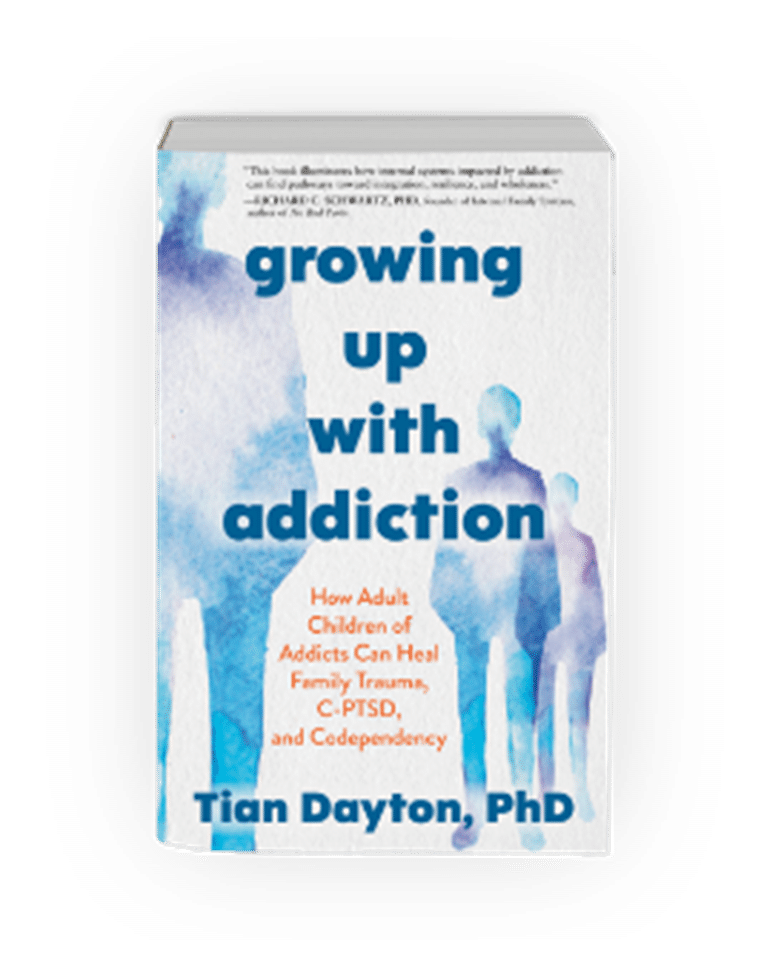
To learn more and explore Dr. Dayton’s book Growing Up with Addiction: How Adult Children of Addicts Can Heal Family Trauma, C-PTSD, and Codependency>>